The Silent Crisis of Data Integrity in Autonomous AI Agent Architectures

As artificial intelligence applications systematically scale from reactive conversational bots to fully autonomous agents executing complex, multi-step business logic, their operational reliability is increasingly tethered to the velocity and accuracy of the underlying data layer. Modern enterprise AI architectures frequently operate under a hazardous premise: the persistent assumption that the data read by an autonomous agent reflects the absolute, current state of physical or digital reality. Within complex distributed computing environments characterized by cross-region replication, microservices, and asynchronous database architectures, this foundational assumption regularly fails. Industry specialists and database architects observing enterprise deployments note that systemic failures in agentic systems rarely originate within the large language model weights or the prompt engineering layers. Instead, critical breakdowns emerge at the intersection of asynchronous replication lag and the contextual retrieval mechanisms powering modern Retrieval-Augmented Generation frameworks.
The architectural paradigm of artificial intelligence has undergone a fundamental shift over the past several years, moving away from static model fine-tuning toward dynamic, state-driven agent loops. In these contemporary architectures, the database functions as the active, working memory of the artificial intelligence. When an autonomous agent is assigned a complex objective, it queries external data stores to construct its context window, which subsequently dictates the foundational constraints of the large language model’s reasoning chain. If the retrieved data is even marginally outdated due to replication latency, the entire downstream reasoning process is compromised. Enterprise architects are therefore forced to transition their operational focus from merely guaranteeing high availability of data to strictly verifying contextual integrity across distributed nodes.
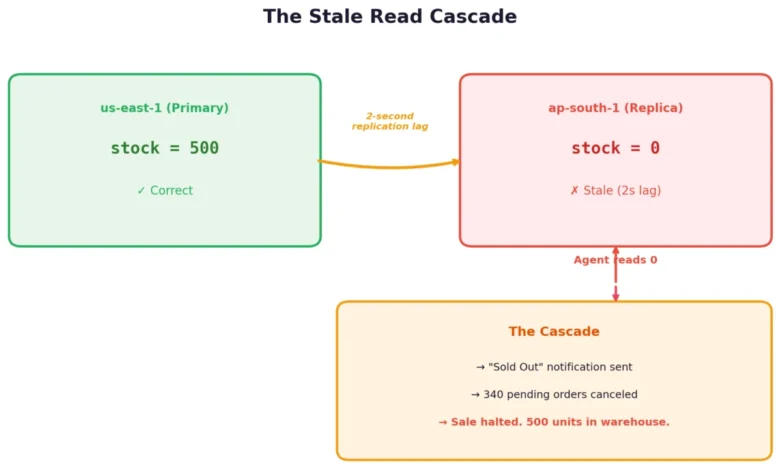
The operational hazard posed by asynchronous lag acts as a silent poison within enterprise AI workflows. In traditional, human-facing web applications, asynchronous replication strategies are standard practice designed to scale global read operations with minimal write latency penalties. If a standard web user views an updated social media post or product inventory metric five hundred milliseconds late, the user experience degradation is negligible or entirely unnoticeable. However, for an autonomous software agent executing high-speed transactional operations, a five hundred millisecond replication delay can introduce catastrophic logic failures. When a fast-moving agent writes a decision to a primary database node and immediately reads from a lagging replica, it inadvertently treats stale, superseded data as absolute ground truth. The agent then proceeds to execute a logically coherent, multi-step operational plan based entirely on factually incorrect inputs. Within the operational economics of enterprise artificial intelligence, a rapid response that is logically flawed proves significantly more expensive than a marginally delayed response anchored in verified truth.
This phenomenon frequently manifests as stale-read failures, where memory directly betrays internal system logic. Consider, for instance, an automated inventory reconciliation agent operating during a high-volume flash sale event. The agent reads current stock levels from a regional read replica, calculates that sufficient units remain to fulfill a bulk order, writes the confirmed transaction to the primary database, and triggers automated fulfillment pipelines. However, because of asynchronous replication lag, the regional replica failed to reflect purchases executed milliseconds prior by competing agent instances or human buyers. The agent did not commit a logical reasoning error; rather, it executed flawless logical operations upon a fundamentally poisoned context.
Once an autonomous agent writes an incorrect operational conclusion back to the active database, that erroneous entry transforms into persistent, long-term memory. Future retrieval cycles pull this corrupted history into subsequent context windows, generating a self-reinforcing enterprise cycle known as hallucination debt. Because large language models lack an intrinsic temporal compass and cooperatively treat retrieved database records as current, immutable facts without hesitation, the burden of verifying contextual integrity falls entirely upon the underlying system architecture. Without rigorous data-layer safeguards, enterprise AI deployments risk compounding initial latency errors into systemic data corruption across entire organizational repositories.
To combat these vulnerabilities, enterprise database engineering teams have categorized replication methodologies into distinct architectural patterns designed to match specific system truth requirements. The first major approach, precision through global consistency, addresses high-stakes workloads where the operational cost of a stale read remains entirely unacceptable. Such workloads typically encompass user permissions frameworks, security authorization policies, core financial ledgers, and immutable system instructions. For relational database environments, platforms such as Amazon Aurora Global Database mitigate the consistency gap through features like Global Write Forwarding combined with strict consistency configurations. By establishing session-level consistency parameters, an agentic system is forced to wait until its own forwarded write operations have fully replicated across regions prior to executing subsequent reads. For next-generation distributed applications, technologies such as Amazon Aurora DSQL introduce native synchronous strong consistency across multiple geographic availability zones, allowing multi-agent enterprise networks to scale globally without sacrificing factual accuracy or permitting mid-thought state changes.
Conversely, for enterprise workloads requiring high-velocity global availability at massive scale—such as conversational chat histories, real-time user session states, and personalized agent memory stores—multi-leader architectures like Amazon DynamoDB Global Tables provide an alternative framework. In these environments, engineers deploy conditional write operations using rigorous expression evaluations that verify version timestamps or attribute states before committing updates. If a concurrent agent instance has modified the underlying record since it was last retrieved, the database issues a conditional check failure exception. This programmatic signal instructs the agent to halt execution, re-read the current state, and re-evaluate its decision path rather than blindly overwriting parallel computational processes, thereby eliminating lost update anomalies without enforcing restrictive global synchronization locks.
For extreme high-velocity intake scenarios, such as Internet of Things telemetry ingestion, real-time security log analysis, and high-frequency financial sensor feeds, leaderless distributed architectures like Amazon Keyspaces provide predictable, low-latency performance. By automatically replicating incoming data across multiple availability zones and enforcing localized quorum standards for both write and read operations, these systems ensure that real-time analytical agents capture transient anomalies and critical system spikes without creating processing bottlenecks in the primary data ingestion pipelines.
The broader implications of these architectural challenges point toward a permanent evolution in the professional responsibilities of software and data architects. Database replication can no longer be relegated to a background infrastructure concern configured once during initial deployment and subsequently ignored. In the operational reality of autonomous enterprise agents, the stability, consistency, and velocity of the underlying data layer serve as the direct, inescapable prerequisite for the trustworthiness of the artificial intelligence itself. By deliberately matching replication models to the specific reasoning requirements of autonomous agents, engineering organizations move beyond traditional data management, establishing a new discipline of context architecture that ensures every automated decision is anchored in a unified version of digital truth.
Related posts: